Over 1000 Pakistani Medical Grads Matched in US Residency Programs in 2026
Over 1000 Pakistani medical graduates have been matched in the 2026 NRMP (National Residency Matching Program), according to APPNA (The Association of Physicians of Pakistani Descent of North America). This 2026 program was the largest in history, offering 44,344 positions to 53,373 registered applicants, with over 93% of spots filled. Among Pakistani medical graduates matched, Karachi's Dow Medical University graduates led the pack with 132 matches, followed by 109 from Lahore's King Edwards Medical University and 60 from Karachi's Aga Khan Medical College.
 |
| Top Pakistani Medical Schools in US Residency Programs. Source: APPNA |
Nearly 3,000 Indian medical graduates made up the largest group among international medical graduates matched in US residency programs this year. Pakistanis were second with over 1,000 matches. Over 9,000 International Medical Graduates (IMGs) (including both U.S. citizens and non-U.S. citizens) matched into U.S. residency positions, with non-U.S. IMGs seeing a 56.4% match rate.
 |
| Foreign Medical Residents at Parkview Hospital in Indiana. Source: Mary Bowden MD |
This year, the presence of a large number of foreign doctors has become a political issue. In some programs, such as Parkview hospital in Indiana, 14 of 15 residents who matched in the internal medicine program are from foreign countries. 12 of them are from Pakistan. Another program at Baptist Hospital of Southern Texas, all 13 residents are foreign medical graduates. Of these 6 are from Pakistan.
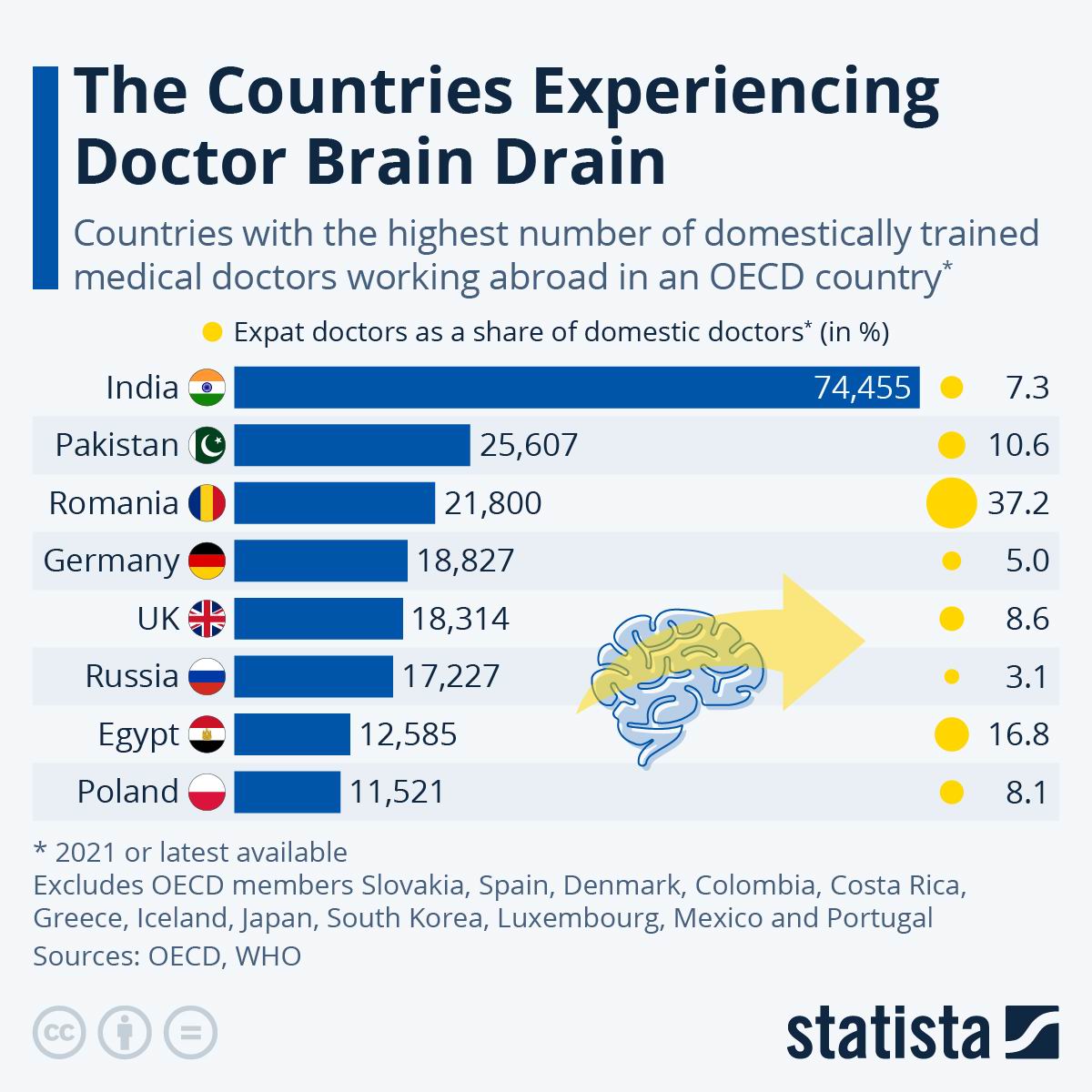 |
| Doctor Brain Drain. Source: Statista |
Pakistani-American doctors make up the second largest population of foreign doctors in America. And they are quite successful. For example, Dr. Mansoor Mohiuddin, a 1989 graduate of Karachi's Dow Medical College, made global headlines when he implanted a pig heart in a patient at University of Maryland School of Medicine. Considered one of the world’s foremost experts on transplanting animal organs, known as xenotransplantation, Muhammad M. Mohiuddin, MD, Professor of Surgery at UMSOM, joined the UMSOM faculty five years ago and established the Cardiac Xenotransplantation Program with Dr. Griffith. Dr. Mohiuddin serves as the program’s Scientific/Program Director and Dr. Griffith as its Clinical Director.
 |
| Top Countries of Origin of Foreign Doctors in the US. Source: OECD |
The pervasive presence of South Asian doctors in the United States is confirmed by OECD (Organization for Cooperation and Development) statistics on foreign doctors in OECD member nations. While India has remained the top source of foreign doctors since 2013, Pakistan has moved up from third to second spot in this period. As of 2016, there were 45,830 Indian doctors and 12,454 Pakistani doctors among 215,630 foreign doctors in the United States. India (45,830) and Pakistan (12,454) are followed by Grenada (10,789), Philippines (10,217), Dominica (9,974), Mexico (9,923), Canada (7,765), Dominican Republic (6,269), China (5,772), UAE (4,635) and Egypt (4,379).
In percentage terms, 21% of foreign doctors come from India, 6% from Pakistan, 5% each from Grenada, Philippines and Dominica and 4% from Mexico.
 |
| Pie Chart of Origins of Foreign Medical Graduates in US. Source: OECD |
Many of these "foreign doctors" are US citizens, born and raised in the United States, who travel abroad to study at foreign medical schools. Their reasons vary from ease of admissions to lower costs. This is particularly true of the medical schools in the Caribbean nations.
Many Caribbean nations have established medical schools to especially cater to the demand from the United States. In 2007, Pakistan, too, set up Dow International Medical College as part of Dow University of Health Science (DUHS).
Indians and Pakistanis also make up the top two nationalities among 66,211 foreign doctors in the United Kingdom. There are 18,953 doctors from India, 8,026 from Pakistan, 4.880 from Nigeria and 4,471 from Egypt in the UK.
The list of 25,400 foreign doctors in Canada is topped by South Africans (2,604) followed by Indians (2,127), Irish (1,942), British (1,923), Americans (1,263) and Pakistanis (1,087).
There are 25,607 Pakistani medical school graduates currently working in all of the OECD member countries which are considered the rich industrialized nations. These Pakistani doctors account for 10.6% of 242,000 Pakistan-trained doctors practicing now. 74,455 Indian doctors working in OECD nations make up 7.3% of about 1,020,000 of all India-trained doctors in practice.
In spite of losing 10.6% of its doctors to "brain drain" compared to India's 7.3%, Pakistan still has more doctors per capita (1.1 per 1000 population) than India (0.7 doctors per 1000 population), according to the World Bank. Pakistani medical colleges admit 16,000 students a year compared to 92,000 in India.
As the populations age and demand for medical services grows in the West, more and more of it is being met by recruiting health care workers, including doctors and nurses, from the developing world.
Related Links:
Haq's Musings
South Asia Investor Review
Pakistani-American Health Professional Featured in Netflix Documentary "Pandemic"
Pakistan is the 3rd Largest Source of Foreign Doctors in America
Pakistani-Americans Largest Foreign-Born Muslim Group in Silicon Valley
Racial Slurs Hurled at Pakistani-American Doctor in St. Louis, Missouri
Islamophobia in America
Silicon Valley Pakistani-Americans
Pakistani-American Leads Silicon Valley's Top Incubator
Silicon Valley Pakistanis Enabling 2nd Machine Revolution
Pakistani-American Surgeon Implants Pig Heart in Human
Pakistani-American Ashar Aziz's Fire-eye Goes Public
Pakistani-American Doctor Honored By President Obama
Pakistani-American's Game-Changing Vision
Minorities Are Majority in Silicon Valley
Over A Million Pakistani University Students Enrolled in STEM Fields


Comments
https://timesofindia.indiatimes.com/world/us/going-to-be-a-civil-war-maga-enraged-as-foreign-doctors-secure-us-residency-slots-on-match-day/articleshow/129751777.cms
The digital landscape has erupted into a firestorm of controversy following the release of the National Resident Matching Program (NRMP) results. What began as a data release has spiralled into a heated national debate over immigration, medical standards, and the future of the American healthcare workforce.
One widely shared post warned of a "Civil War" if immigrants weren't "stopped from coming" and "removed from US soil." "Their average IQ’s are 76…..but they get trained, instead of Americans, to become doctors in the USA???" it said.
https://x.com/KatyinIndy/status/2035735218699788441?s=20
"We didn’t ask them here…..we don’t want them here….get them out of our country! 3rd world trash have no right to steal the life & future from an American……END THIS NOW!!!" it added.
"The Great Replacement in reality, again," added another
https://x.com/MaryBowdenMD/status/2035431027347202153?s=20
"Recent federal immigration policy changes have increased attention to visa sponsorship considerations in residency recruitment for foreign-born candidates," the NRMP noted in a press release.
"I think it shows you that program directors are a little bit risk-avoidant for those visa issues," Bryan Carmody, MD, who reports extensively on the match and medical education via his blog Sheriff of Sodium, told MedPage Today.
While U.S. MD seniors maintained a high match rate of 93.5%, thousands of U.S. applicants (including U.S. citizen IMGs and DOs) still found themselves unmatched, fuelling the narrative that "Americans are being sidelined."
Many in the comments pointed out that most IMGs fill slots in Primary Care and Psychiatry—fields that are often undersubscribed by US graduates. Most US seniors go unmatched because they apply in highly competitive specialities rather than the internal medicine or rural roles that IMGs typically occupy.
The introduction of a $100,000 H-1B visa fee in late 2025 has become a central battleground. Supporters of the fee argue it protects American workers by making it expensive to hire foreign labour. Healthcare advocates warn the fee creates "medical deserts" in rural areas that rely almost entirely on IMGs.
With the AAMC projecting a shortage of 86,000 physicians by 2036, legislators are currently debating the 'H-1Bs for Physicians and the Healthcare Workforce Act' to waive these fees. To some, it’s a necessary fix for a dying healthcare system; to others, it’s a "tax break for a foreign
@MaryBowdenMD
Here’s an internal medicine program in Massachusetts putting India first.
25 of 26 of residents are from foreign countries. 22 of 25 are from India.
India has a severe physician shortage - why are they sending their talent to America?
https://x.com/MaryBowdenMD/status/2038241822388961509?s=20
-------------
Krutika Kuppalli, MD FIDSA
@KrutikaKuppalli
Imagine being a physician who has taken the Hippocratic Oath—to do no harm, act in patients’ best interest, ensure justice, respect every person, and uphold integrity
Then you go on social media and spew racist rhetoric toward newly matched medical students who will soon be your colleagues.
That behavior violates every one of those principles.
https://x.com/KrutikaKuppalli/status/2038079536076587059?s=20
----------
Charlotte Clymer 🇺🇦
@cmclymer
I think it's pretty cool that talented medical residents from around the world move to the American Midwest to be great doctors. If your issue is that more American medical residents should do this, then you should tell them that. That's on them, not on these professionals.
https://x.com/cmclymer/status/2037974683342016995?s=20
More than 1,400 Pakistani medical graduates have secured residency placements in the United States in 2026, according to the Pakistan Medical and Dental Council.
That is up from 1,061 placements in 2025, an increase of at least 339 in a single year.
PMDC called it a major achievement for Pakistan's medical education sector and said it reflects the growing competitiveness of Pakistani doctors seeking postgraduate training abroad.
The PMDC President congratulated the graduates, crediting students, teachers, institutions, and regulators working to raise standards at home.
To match, doctors must clear US licensing examinations and certification before entering the National Resident Matching Program.
Across the 2026 Match, 38,354 applicants secured first-year positions, including 9,682 international medical graduates with Pakistan among the countries contributing to that pool.
https://www.uabmedicine.org/news/uabs-sheikh-is-one-of-the-first-female-transplant-surgeons-from-pakistan/
University of Alabama at Birmingham Assistant Professor Saulat Sajjad Sheikh, MBBS Division of Transplantation is one of the first female transplant surgeons from her originating country, Pakistan.
Sheikh attended medical school at the Aga Khan University in Karachi, Pakistan, where she was conferred the “Best Graduate” award. She subsequently completed her general surgery residency at York Hospital, York, Pennsylvania. Sheikh graduated from UAB’s Abdominal Transplantation and Hepatobiliary Surgery Fellowship in 2020.
During her residency, Sheikh considered specializing in gastrointestinal surgery; but after experiencing the gratification of changing an individual’s life by successfully transplanting a kidney or liver, abdominal transplant surgery was her new goal. Curing end-stage organ disease and offering a renewed chance at life for a patient became a passion for Sheikh.
Sheikh had several barriers to overcome before she could become a transplant surgeon. The Journal of Pakistan Medical Association reported in 2016 that 69.6 percent of registered medical doctors were male. When she decided on the field, Sheikh knew it was rare for a female medical doctor to specialize in surgery, let alone abdominal transplantation.
“Transplant surgery in Pakistan is not easily accessible, and there are only a few established transplant centers,” Sheikh said. “It was such a privilege and honor to attend one of the finest medical schools in Pakistan and then complete the rest of my training in the United States.”
According to a recent study conducted by Aga Khan University Hospital, where Sheikh attended medical school, 72 percent of female surgeons in the AKUH Department of Surgery said cultural barriers to a surgical career existed because of their gender. Further, about 40 percent of the women report having been discouraged by family or close friends from pursuing surgery as a career field.
Not only did she face gender barriers, but Sheikh also had personal challenges. She simultaneously began her two-year fellowship while single-handedly caregiving for her 7-month-old daughter. At the time, her husband, current UAB Acute Care Surgery Fellow Zain Hashmi, M.D., was still finishing his general surgery residency at the Sinai Hospital of Baltimore.
“It was certainly difficult raising a child and completing my fellowship, but I had to remind myself of my ‘why,’” Sheikh said. “I chose UAB because of the potential for growth, mentorship and stability. Dr. Jayme Locke is an incredible role model for me. She was the only female faculty in transplant at UAB when she started here. I have been with the UAB Division of Transplantation for just over two years, and I feel like I am barely scratching the surface with how far I can go.”
As an only female child from a conservative family, Sheikh said she was lucky her parents permitted her to capitalize on the available opportunities and sent her off into the world to pursue her goal of becoming a transplant surgeon. Both her mother and father are retired physicians —her mother is an OBGYN, and her father practices family medicine.
“My parents were and continue to be supportive of my pursuing my dreams to become a transplant surgeon, even though they often received side comments from the community, doubting my career and life path,” Sheikh said. “When I first started out on this journey, it felt like a distant dream; but now here I am, living my dream every day.”
https://www.dawn.com/news/2022247
Agreement signed to support 66 PhD scholars while expanding opportunities for advanced education, research and academic exchange
------------------
ISLAMABAD: Pakistan and the United States have renewed their longstanding partnership in higher education through a new five-year agreement between the Higher Education Commission (HEC) and the United States Educational Foundation in Pakistan (USEFP).
According to the federal ministry of education, the renewal of partnership reaffirmed shared commitment to academic excellence, human capital development, research, and international educational cooperation.
The agreement was signed by USEFP Executive Director Dr Peter Moran and HEC Executive Director Professor Dr Ziaul Haq at the USEFP headquarters in Islamabad on Tuesday.
Speaking on the occasion, Dr Moran stated: “USEFP-administered programs empower participants to develop skills and practical knowledge that directly benefit Pakistan’s development across all sectors of society. We are grateful for the continued partnership of the governments of the United States and Pakistan in advancing this mission.”
Prof Haq on the occasion remarked: “The HEC–Fulbright long-standing partnership stands as a hallmark of educational cooperation and continues to deliver immense value to Pakistan’s higher education landscape.”
“The United States is proud to renew this partnership with Pakistan’s Higher Education Commission,” said David Moyer, Acting Minister Counselor for Public Diplomacy at the US Embassy.
According to a press release issued by the embassy, the programmes supported through the agreement reflect both governments’ investment in empowering future leaders, scholars, and professionals who will contribute to Pakistan’s progress while strengthening US-Pakistan ties.
“Through this partnership, Pakistani students and scholars gain access to the renowned American education system while improving capacity across Pakistan’s higher education sector. Americans coming to Pakistan collaborate on innovative research, business, and public health ventures that benefit U.S. universities, businesses, and the wider public,” it added.
Meanwhile, a statement issued by the education ministry said Minister of State for Federal Education and Professional Training Wajiha Qamar took the lead from the ministry in advancing Pakistan–United States educational cooperation.