Posts

Showing posts with the label current account deficit

Which Country is a Bigger Beggar? India or Pakistan?

Image
Most countries in the world today borrow money from various sources to finance their budget deficits. So do India and Pakistan. So why is it that only Pakistan's borrowing money gets labeled "begging"? Is it not begging when India borrows a lot more money than does Pakistan? Or is it that only borrowing money from the IMF qualifies as "begging"? Let's look into this double standard.  Currently, India's public debt to GDP ratio is 80% while Pakistan's is about 74%. India's private debt to GDP ratio is 17%, twice that of Pakistan. Do these figures mean that India is a bigger beggar than Pakistan?  Debt-to-GDP Ratios Around the World. Source: Visual Capitalist India is consistently among the largest borrowers from International Financial Institutions (IFIs), particularly the World Bank and the Asian Development Bank (ADB). It has been the top debtor to the World Bank for several years and a major borrower from the ADB.  India’s outstanding loan bala...
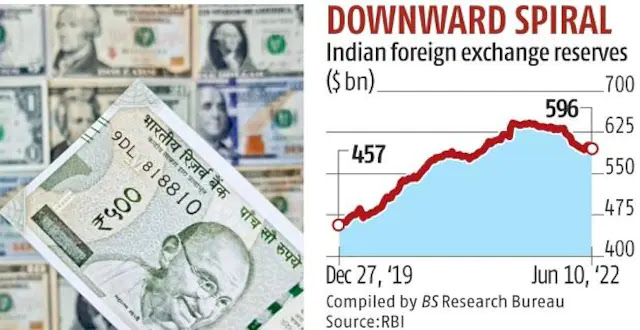
India's Forex Reserves Fall As Foreign Investors Head For The Exits

Image
India's foreign exchange reserves are falling rapidly as foreign investors flee and the country's trade and current account deficits widen. More than $267 billion worth of India's external debt of the total $621 billion is due for repayment in the next nine months. This repayment is equivalent to about 44% of India's foreign exchange reserves. This combination of investors' exodus, widening twin deficits and short-term debt repayments has caused the Indian rupee to hit new lows. Unlike China and other nations that have accumulated large reserves by running trade surpluses, India runs perennial trade and current account deficits. The top contributor to India's forex reserves is debt which accounts for 48%. Portfolio equity investments known as “hot” money or speculative money flows account for 23% of India's forex reserves, according to an analysis published by  The Hindu BusinessLine .  India's Declining Forex Reserves. Source: Business Standard Investo...

Current Debt Crisis Threatens Pakistan's Future

Image
Pakistan is battling massive twin deficits, deteriorating foreign currency reserves, low exports, diminishing tax revenues, a weak currency, unsustainable external debt payments, and soaring sovereign debt. This crisis has forced the country to seek  IMF (International Monetary Fund) bailout , the 13th such request in Pakistan's 72 year history. Pakistan Debt Service: Source SBP Pakistan's debt repayment costs rose to $5.4 billion for first half of fiscal 2019 ( July 2018-Dec 2018), up from $7.5 billion for the entire fiscal 2018 (July 2017-June 2018), according to the  State Bank of Pakistan . At this rate, the total debt service cost for current fiscal 2019 will exceed $11 billion, adding to the nation's  debt crisis . Pakistan's External Debt. Source: Wall Street Journal This $11 billion debt service cost will add to the projected trade deficit of nearly $40 billion for the current fiscal year. How can Pakistan fund this balance of payments deficit of ab...

Moody's Expects Pakistan's New Mini Budget to Foster Exports and Import Substitution

Image
Pakistan's new government led by Prime Minster Imran Khan has inherited large twin deficits. The new "mini budget" announced by Finance Minister Asad Umar "will support Pakistan’s manufacturing sector, fostering exports and import substitution, and help narrow the current-account deficit",  says a January 31, 2019 report by Moody's investor service.  The report adds that the tax incentives given to manufacturing and exports-oriented industries "will keep Pakistan’s budget deficits wider for longer, potentially eroding the credibility of government efforts to achieve fiscal consolidation." Pakistan Mini Budget Announced January 23, 2019. Source: Shajar Capital Here's an excerpt of Moody's report on the immediate downsides of the measures announced by Umar on January 23, 2019: “We expect the deficit to widen to 6% of GDP in fiscal 2019 because revenue growth is likely to be below government projections, given slower economic growth ...

Pakistan's Debt Crisis: Fact or Fiction?

Image
Pakistan is taking on significant amounts of domestic and foreign debt to finance its budget deficits and to support major energy and infrastructure development projects as part of  China-Pakistan Economic Corridor  (CPEC).  Over one-third of this public debt is external debt denominated in US dollars, Euros and other hard currencies. At the same time, Pakistan's exports have declined over the last several years and the country's current account deficits have grown. Pakistan's External Debt. Source: Wall Street Journal Critics Warnings:  Critics believe that Pakistan is facing a severe debt crisis. They fear that it could get caught in a big  debt trap laid by foreign governments . They warn that Pakistan will go broke. It will be unable to repay these mounting debts. Are they right? To answer this question, Dr. Ishrat Husain, a former central banker and governor of the State Bank of Pakistan, has  analyzed Pakistan's debt  as of June 30, 2017...