Posts

Showing posts with the label debt

Which Country is a Bigger Beggar? India or Pakistan?

Image
Most countries in the world today borrow money from various sources to finance their budget deficits. So do India and Pakistan. So why is it that only Pakistan's borrowing money gets labeled "begging"? Is it not begging when India borrows a lot more money than does Pakistan? Or is it that only borrowing money from the IMF qualifies as "begging"? Let's look into this double standard.  Currently, India's public debt to GDP ratio is 80% while Pakistan's is about 74%. India's private debt to GDP ratio is 17%, twice that of Pakistan. Do these figures mean that India is a bigger beggar than Pakistan?  Debt-to-GDP Ratios Around the World. Source: Visual Capitalist India is consistently among the largest borrowers from International Financial Institutions (IFIs), particularly the World Bank and the Asian Development Bank (ADB). It has been the top debtor to the World Bank for several years and a major borrower from the ADB.  India’s outstanding loan bala...

Following the Money: Insights into Pakistan's Budget 2024-25

Image
A look at Pakistan's current fiscal year 2024-25 budget helps gain insights into how the country is run. It shows the money flows from the key sources of revenue and the nation's spending priorities. Total planned federal spending for the current fiscal year is Rs.18,900 billion (about 69 billion U.S. dollars). This figure does not include the transfer of Rs. 7,438 (US$ 26 billion) from the federal government to the provinces. Under the 18th amendment passed in 2010, the federal government is obligated to share 57.5% of its revenue with the provinces. The federal government is primarily responsible for  defense , foreign affairs,  debt servicing , foreign trade, ports and shipping, and development programs, while food and  agriculture ,  education , healthcare and housing are devolved to the provinces. There still appears to be some overlap of domestic responsibilities between the federation and the provinces.  Pakistan's Budget 2024-25 at a Glance. Visualizatio...

Pakistan Cut Public Debt in Half On Musharraf's Watch in 1999-2008

Image
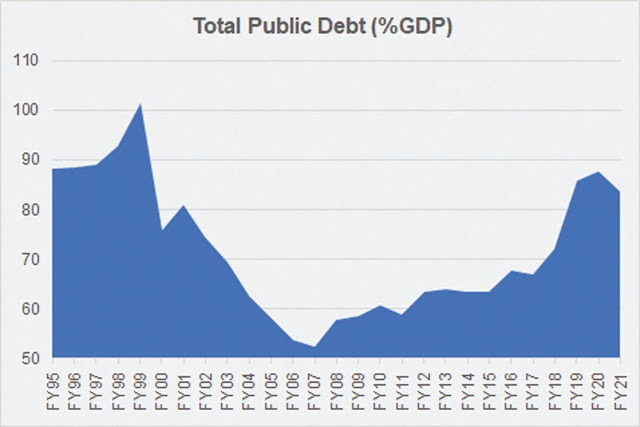
In 1999, President Pervez Musharraf inherited a massive debt of over 100% of GDP run up by the Pakistan Peoples Party and the Pakistan Muslim League (Nawaz) governments in 1990s. Musharraf's policies not only revived the bankrupt economy but also brought down debt to 52% of GDP by 2007.  Pakistan Debt to GDP 1995-2021. Source: IMF PPP Government's 2008 Letter to IMF: In a letter to the International Monetary Fund in 2008, the PPP government hailed Musharraf's economic record without mentioning his name in the following words: "Pakistan's economy witnessed a major economic transformation in the last decade (2000-2008). The country's real GDP increased from $60 billion to $170 billion, with per capita income rising from under $500 to over $1000 during 2000-07.....the volume of international trade increased from $20 billion to nearly $60 billion. The improved macroeconomic performance enabled Pakistan to re-enter the international capital markets in the mid-2000s....

India's Economy Grew Only 0.2% Annually in the Last Two Years

Image
The Indian government has reported an 8.4% jump in economic growth in the July-to-September period compared with a contraction of 7.4% for the same period a year earlier. The average GDP growth in India over the last two years has averaged just 0.2% per year. The news appears to indicate strong recovery after a big economic hit suffered from the COVID pandemic since early 2020.  Pakistan's economy fared relatively better during the pandemic. Pakistan's GDP rose 0.5% in 2020 and 3.9% in 2021. As a result, Pakistan now fares better than India on multiple indices including Hanke  Misery Index , World  Happiness Index ,  Food Affordability  Index and World  Hunger Index .   India's Economy: Welcoming the news, renowned Indian economist Kaushik Basu tweeted :  "India's growth of 8.4% over Jul-Sep is welcome news. But it'll be injustice to India if we don't recognize, when this happens after -7.4% growth, it means an annual growth of 0.2% over 2 ye...

Current Debt Crisis Threatens Pakistan's Future

Image
Pakistan is battling massive twin deficits, deteriorating foreign currency reserves, low exports, diminishing tax revenues, a weak currency, unsustainable external debt payments, and soaring sovereign debt. This crisis has forced the country to seek  IMF (International Monetary Fund) bailout , the 13th such request in Pakistan's 72 year history. Pakistan Debt Service: Source SBP Pakistan's debt repayment costs rose to $5.4 billion for first half of fiscal 2019 ( July 2018-Dec 2018), up from $7.5 billion for the entire fiscal 2018 (July 2017-June 2018), according to the  State Bank of Pakistan . At this rate, the total debt service cost for current fiscal 2019 will exceed $11 billion, adding to the nation's  debt crisis . Pakistan's External Debt. Source: Wall Street Journal This $11 billion debt service cost will add to the projected trade deficit of nearly $40 billion for the current fiscal year. How can Pakistan fund this balance of payments deficit of ab...

Pakistan's Debt Crisis: Fact or Fiction?

Image
Pakistan is taking on significant amounts of domestic and foreign debt to finance its budget deficits and to support major energy and infrastructure development projects as part of  China-Pakistan Economic Corridor  (CPEC).  Over one-third of this public debt is external debt denominated in US dollars, Euros and other hard currencies. At the same time, Pakistan's exports have declined over the last several years and the country's current account deficits have grown. Pakistan's External Debt. Source: Wall Street Journal Critics Warnings:  Critics believe that Pakistan is facing a severe debt crisis. They fear that it could get caught in a big  debt trap laid by foreign governments . They warn that Pakistan will go broke. It will be unable to repay these mounting debts. Are they right? To answer this question, Dr. Ishrat Husain, a former central banker and governor of the State Bank of Pakistan, has  analyzed Pakistan's debt  as of June 30, 2017...