Posts

Showing posts with the label Electricity

Solar Energy Revolution Sparks Battery Boom in Pakistan

Image
After installing over 50 GW of solar panels as of early 2026, Pakistanis are now adding batteries at a rapid pace. The country has imported nearly 7.6 GWh of batteries, with nearly 60% of that total arriving during 2025 alone. Pakistanis are now installing batteries at a rate exceeding 5 GWh annually, according to a recent report by  Renewable First . Batteries enable consumers to store excess solar electricity generated during daylight hours for use at night and to smooth out demand on the grid. Batteries also contribute to national grid stability, reducing costs and improving overall energy security for energy-import-dependent Pakistan.   Pakistan's Battery Boom. Source: Renewable First By FY25, 7.3 million households in Pakistan had solar installed on their rooftops; out of a total 40 million households in the country, that makes nearly 1 in 5 of all Pakistani homes, the report says. With the battery boom gaining pace, around 282,000 solarized households, roughly 4%, now ha...

Pakistan Electricity Consumption Up 21% in Just Two Years

Image
Pakistan is experiencing soaring demand for electricity across all of the sectors of its economy. The new demand is being met by rapidly growing deployment of distributed solar, estimated at 38 GW as of June, 2025. In 2025, 44% of solar deployment was residential, followed by industry (26%), agriculture (21%) and commercial users (9%). The expansion of distributed solar has enhanced electrification across the economy, lifting Pakistan's  electrification  rate to 21.7% in FY2025 from 17% in FY2023, close to the global average of 22%. This surge to over 200 terawatt-hours of electricity is not reflected in official data, according to a report by  Ember Energy  titled "The solarization of Pakistan's energy economy".  The  solar energy revolution  in Pakistan is led by consumers. Driven by soaring electricity costs, unreliable grid infrastructure, and cheap imported solar panels, millions of households and businesses have installed rooftop solar. This rapi...

Solar Power Boom in Pakistan

Image
Falling solar panel prices and soaring rates for grid electricity are driving a renewable power boom in Pakistan. A second factor spurring the growth in clean energy installations is the requirement of major western apparel brands for garments and textile manufacturers to switch to  clean energy . As a result, the solar panel imports in the country jumped from 2,800 MW in 2022 to 5,000 MW in 2023, in spite of stringent import controls imposed by the government. Solar imports are on track to reach 12,000 MW in 2024, according to solar installers. The total current installed generation capacity in Pakistan is around 40,000 MW. Grid electricity demand in Pakistan plunged in 2023 by nearly a sixth and a decline in 2024 would mark the first time in 16 years that annual electricity use has fallen consecutively, data from energy think tank Ember showed, according to  Reuters . Pakistan Solar Panel Imports. Source: PV Magazine Omar Malik, the CEO of Shams Power, a major solar system c...

Pakistan Plans to Convert Coal-Fired Power Plants to Burn Domestic Thar Lignite

Image
With a new 330 MW mine-mouth coal-fired power plant in Tharparkar, Pakistan has now reached 990 MW of power fueled by the local lignite. Thar coal production is being expanded and plans are in place to convert three more imported anthracite coal fired plants to burn domestic lignite as soon as its production is expanded and a rail link is completed to transport the fuel to the rest of the country. Plans call for using Thar coal in three coal-fired plants currently burning imported coal: Sahiwal Coal Power, China Hub Coal Power and Port Qasim Coal, each of 1,320MW installed capacity. These power plants may require some limited equipment changes to burn domestic lignite. It is worth noting that Pakistan contributes less than 1% of the global greenhouse-gas emissions. Using the higher polluting domestic Thar lignite is crucial to Pakistan's desperate need for cheap energy to spur industrialization for economic growth without running into recurring  balance of payments  crises....

Pakistan Nuclear Power Generation Soared 66% in 2021

Image
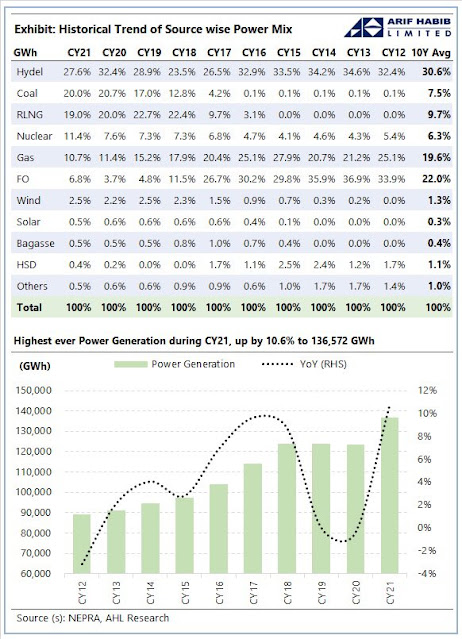
Nuclear power plants in Pakistan generated 15,540 GWH of electricity in 2021, a jump of 66% over 2020. Overall, Pakistan's power plants produced 136,572 GWH of power, an increase of 10.6% over 2020, indicating  robust economic recovery  amid the COVID19 pandemic.  Pakistan Electric Power Generation. Source: Arif Habib Hydroelectric dams contributed 37,689 GWH of electricity or 27.6% of the total power generated, making hydropower the biggest contributor to power generated in the country. It is followed by coal (20%), LNG (19%) and nuclear (11.4%).  Cost Per Unit of Electricity in Pakistan. Source: Arif Habib Nuclear offers the lowest cost of fuel for electricity (one rupee per KWH) while furnace oil is the most expensive (Rs. 22.2 per KWH).  Pakistan Electric Power Generation Fuel MiX. Source: Arif Habib Construction of 1,100 MW nuclear power reactor  K2 unit in Karachi  was completed by China National Nuclear Corporation in 2019, according to  me...

Pakistan: Hopes Rise For Cheap and Abundant Electricity

Image
Pakistani power sector is continuing its march toward cheap indigenous sources of electricity.  Hydropower  component has increased 22%, coal 57% and nuclear 8% while oil is down 54% and natural gas and LNG are down 32% and 15% respectively, according to  Bloomberg . These changes in power mix are expected to help significantly reduce power subsidies that run into hundreds of billions of rupees contributing to large annual budget deficits. Data From NEPRA. Courtesy Pakistan Today Coal's contribution to power mix now stands at just 21%, in spite of 57% increase in use of coal in Fiscal Year 2020. It is still almost half of the global average of 38% of electricity produced from coal. Overall, the contribution of fossil fuels in electricity generation is now about 54%, down from nearly 66% a few years ago. Pakistan Power Generation Mix. Source: Bloomberg Hydropower  and  natural gas  now contribute 32% each, making them the biggest sources of ele...

Electric Power Rates in India and Pakistan

Image
Pakistan National Electric Power Regulatory Authority (NEPRA) has cut electricity price by 2.99 rupees (2.7 U.S. cents) per unit under the fuel adjustment for the month of December, 2017, according to  news reports . This reduction brings the price per kilowatt-hour to Rs. 5.11 (4.60 US cents), down from Rs. 8.10 (7.30 US cents). Power Rate in Pakistan: Reduction brings the price per kilowatt-hour to Rs. 5.11 (4.60 US cents), down from Rs. 8.10 (7.30 US cents). The CPPA (Central Power Purchasing Authority) said total energy was generated at the cost of Rs. 25.24 billion, or  Rs. 3.52/unit  for the month of November, 2017. The reduction in the actual generation cost is mainly because of a decline in fuel prices, zero use of high-speed diesel in the power plants and higher contribution from the cheapest source – hydropower. The furnace oil (Rs. 9.03 per unit) has been replaced by domestic natural gas at  Rs. 4.49 per unit  and  liquified natural gas (...

Pakistan to Build Massive Dams for Abundant Water and Power

Image
China and Pakistan have agreed to finance and build two mega dams in Gilgit-Baltistan region of Pakistan. A memorandum of understanding (MoU) for this development was signed by the leaders of the two countries on the sidelines of the Belt and Road Initiative (BRI) summit in Beijing. Actual vs Potential Hydropower in South Asia. Source: Economist Magazine The two dams, called Bunji and Diamer-Bhasha projects, will have the capacity to generate 7,100MW and 4,500MW of electricity respectively. China will provide $27 billion to fund the construction of the two dams, according to media reports . Pakistan's Hydropower Potential:  Pakistan has the potential to generate 59,000MW of hydropower, according to studies conducted by the nation's Water and Power Development Authority (WAPDA). Currently, it's generating only 6,600MW of hydroelectric power, about 11% of the estimated potential.  Media reports indicate that China is prepared to finance and build another 40,000MW...