Posts

Showing posts with the label Women

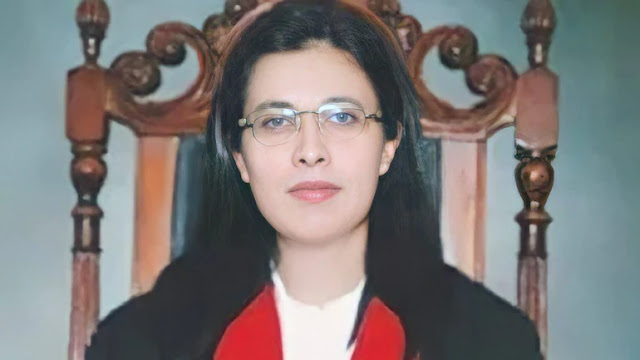
Pakistan Gets First Woman Supreme Court Judge Despite Top Judges' Opposition
Image
Judge Ayesha Malik has been confirmed as Pakistan's first woman Supreme Court judge in the face of strong opposition by the majority of sitting judges of the top court and Pakistan Bar Council. It was two  affirmative votes by the PTI government representatives that helped her win 5-4 confirmation in the Supreme Judicial Council (SJC). Only two of the five sitting Supreme Court judges who are members of the SJC supported her confirmation.  Justice Ayesha Malik The historic nomination of Justice Ayesha Malik was supported by Chief Justice Gulzar Ahmed,  Justice Umar Ata Bandial, ex-judge Sarmad Jalal Osmany, Law Minister Barrister Farogh Naseem and Attorney General (AG) Khalid Jawed Khan. It was opposed by Justice Qazi Faez Isa, Justice Maqbool Baqar, Justice Sardar Tariq Masood and Pakistan Bar Council (PBC) representative Akhtar Hussain opposed the selection.     Justice Ayesha Malik is a Harvard Law School graduate. She started her legal career working wi...

Sindhi Village Girl Umaima Mendhro Launches San Francisco Tech Startup

Image
Vida, a  San Francisco technology startup co-founded by Umaimah Mendhro from Akri village in Sindh, Pakistan, has received $1.3 million funding from Google Ventures, Universal Music Group and others, according to Tech Crunch . The startup bills itself as "socially responsible" with the objective of using technology to provide a way for designers, artists and other creatives  anywhere in the world to make a viable living through their work. Vida CEO Umaima Mendhro joins a growing list of successful Pakistani-American women that includes Shama Zehra in finance, Shaan Kandawalla in technology, Shazia Sikandar in the Arts and Fatima Ali in fine cuisine. “I am from a very small town in Pakistan and was home-schooled much of my life because we didn’t have proper schools around. I taught myself how to cut, sketch, sew, stitch, block print, screen print, oil paint, and more,” she told Tech Crunch. “Yet I couldn’t get myself to pursue art as a profession because I feared I wo...

Pakistani-American Women's Success Stories

Image
Shama Zehra, Shaan Kandawalla, Shahzia Sikandar and Fatima Ali are among the many Pakistani-American women making their mark in America. Shama Zehra is in finance, Shaan Kandawalla in technology, Shazia Sikandar in the Arts and Fatima Ali in fine cuisine. Shama Zehra Shama Zehra is the CEO of Wall Street firm Aligned Independent Advisors . She began her career as an entrepreneur in the apparel industry in Pakistan in 1991 with a women apparel firm co-founded with her mother and sister. Later, she moved in to financial services industry in 1995 where she has worked in Investment Banking, Consumer Credit Products and Private Wealth Management. Prior to forming Aligned, Shama worked with Goldman Sachs, Morgan Stanley, Standard Chartered Bank and MCB Bank, the largest private sector bank in Pakistan in early nineties. Shaan Kandawalla Shaan is the CEO of PlayDate Digital which makes educational applications for kids. She started it in 2012 after many years of experience wor...

Pakistani Women's Growing Particpation in Workforce

Image
While Fareed Zakaria, Nick Kristoff and other talking heads are still stuck on the old stereotypes of Muslim women, the status of women in Muslim societies is rapidly changing, and there is a silent social revolution taking place with rising number of women joining the workforce and moving up the corporate ladder in Pakistan. "More of them(women) than ever are finding employment, doing everything from pumping gasoline and serving burgers at McDonald’s to running major corporations", says a report in the latest edition of Businessweek magazine . Beyond company or government employment, there are a number of NGOs focused on encouraging self-employment and entrepreneurship among Pakistani women by offering skills training and microfinancing . Kashf Foundation led by a woman CEO and BRAC are among such NGOs. They all report that the success and repayment rate among female borrowers is significantly higher than among male borrowers. In rural Sindh, the PPP-led govern...

India Emerges as Low Cost Leader in IVF Baby Supply Chain

Image
Cost arbitrage that began with call center outsourcing from the West to India has now found its way into the low-rent wombs of poor Indian women ! This new growing business has created a global supply chain with low-cost human babies as the final product brought to the West. This business can cut the cost from over $100,000 in the U.S. to less than $6000 per baby in India. It is explained in an Israeli documentary "Google Baby" scheduled to be aired on HBO in the United States tomorrow. The movie follows an Israeli gay man who decided to have low-cost test-tube babies by outsourcing the job to India. Wealthy Americans and Europeans, gay or straight, can now shop online for an egg from an egg donor in the West, use their sperm or from sperm another western donor, and implant the embryo into a surrogate mother in India. These people don't want their European genes to be mixed with those of the poor women in India, but the Indian women are acceptable as cheap surrogate mo...

Cable TV Empowers Women in India and Pakistan?

Freakonomics is a series of books by authors Steven D Levitt and Stephen J Dubner who find data points, patterns, correlations and trends that are often missed by mainstream economists and researchers. For example, the authors see how legalization of abortion may have caused significant crime rates decline in the United States in recent decades. They argue with various statistics to reject other possible explanations like gun control, strong economy, three-strikes laws etc. Authors say that the termination of unwanted pregnancies has led to fewer criminals on the streets of America. In their latest book of the Freakonomics series, Superfreakonomics , the authors cite the findings of two American economists Robert Jensen and Emily Oster that cable TV in 2700 households empowered Indian women to be more autonomous. Cable TV households had lower birthrates, less domestic abuse and kept more girls in school. Here are some highlights from the book about India : 1. If women could choose th...