Posts

Showing posts with the label Nuclear

Pak-Saudi Joint Defense: Is Pakistan A Major Power or Bit Player in the Middle East?

Image
The recently signed “Strategic Mutual Defense Agreement” between Saudi Arabia and Pakistan states that “any aggression against either country will be considered an aggression against both”. It is being seen by some geopolitical analysts as the beginning of an "Islamic NATO". Others, such as Indian-American analyst  Shadanand Dhume , have dismissed Pakistan as no more than a "bit player" in the Middle East. Where does the truth lie?  Pakistan PM Shahbaz Sharif(L) with Saudi Crown Prince MBS Is Pakistan really capable of defending Saudi Arabia and other Arab Gulf nations against external aggression such as the recent Israeli attack on Qatar? Can Pakistan provide a nuclear umbrella to deter aggression against its friends in the Middle East? Or is it too weak economically and unstable politically to provide security guarantees to the GCC (Gulf Cooperation Council) nations like Qatar, Saudi Arabia and the United Arab Emirates?  Let's try and understand the context wh...

Earth Day: Pakistan's Progress Toward Low-Carbon Economy

Image
Pakistan celebrates Earth Day on April 22 every year by organizing various events sponsored by the government and non-government organizations to raise awareness of the issues faced by the earth. Today it is being observed with a range of initiatives, including pledges for zero waste, commitments to sustainable practices, and community-based actions to protect the planet. Pakistan contributes less than 1% of global carbon emissions, but it is among the countries considered most vulnerable to climate change. About a third of the country was devastated by massive  floods  in 2022. The nation committed continued pursuit of nature-based solutions to the problem at  COP26  in Glasgow in 2021. As part of this commitment, the country is planting one of the world's largest  mangrove forests  in the Indus River Delta, a key component of its Ten Billion  Tree Tsunami  campaign launched by former Prime Minister Imran Khan. The area where Pakistan is mak...

Renewable Energy: Clean Electrification of Pakistan's Economy

Image
Access to abundant and cheap electricity is essential for running a modern competitive economy. The rapidly growing power demand for generative AI data centers makes it even more important. The best way to ensure it is in switching to renewable energy sources. That is why Pakistan is in the midst of a renewable power boom. It is ramping up generation of clean energy with solar, hydro, wind and nuclear power. 13 gigawatts of  solar panels  have been imported in the first half of this year alone. Another 10 gigawatts of  hydroelectric  power projects are under construction for completion by 2030, bringing the total hydropower capacity to 20 gigawatts. Pakistan's total nuclear energy production capacity rose to  3,620 MW , when the country's sixth  nuclear power  plant opened two years ago. Pakistan and China have recently signed a $4.8 billion deal to build another 1,200 MW nuclear power plant. There are 36 private  wind projects  pr...

Pakistan's Large and Growing Civil Nuclear Program

Image
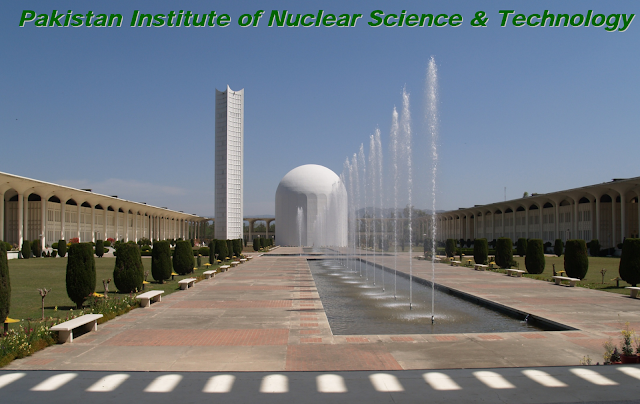
Pakistan's  nuclear weapons  program gets a lot of global attention. But the country also has a large and growing civil nuclear program which has added over 3,500 MW of low-carbon electricity to the national grid. It also supports a variety of agricultural, biological and medical applications. The program relies  particularly on the expertise and contributions of nuclear scientists trained at the Pakistan Institute of Nuclear Science and Technology (PINSTECH) founded in 1965 by Dr. Ishrat Husain Usmani.  Dr. Usmani graduated from Aligarh Muslim University and later did his doctoral research at London's Imperial College under the supervision of Nobel Laureate Niels Bohr. The entire civilian nuclear program in Pakistan operates under the International Atomic Energy Agency's safeguards. PINSTECH, Pakistan Pakistan Nuclear Science and Technology History:    Pakistan started its nuclear program in the 1950s under the United States’ “Atoms for Peace” program, whi...

Indian Diplomat Sharat Sabharwal on Pakistan's "Resilience", "Strategic" CPEC, China-Pakistan "Nexus"

Image
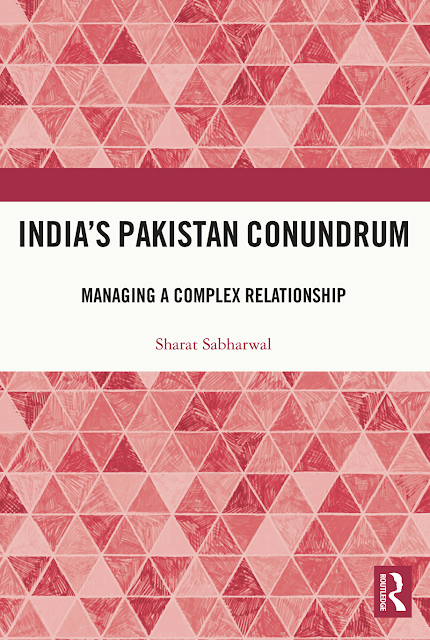
Retired Indian diplomat Sharat Sabharwal in his recently published book "India's Pakistan Conundrum"  disabuses his fellow Indians of the notion that Pakistan is about to  collapse . He faithfully parrots the familiar Indian tropes about Pakistani Army and accuses it of sponsoring "cross-border terrorism". He also writes that "Pakistan has shown remarkable resilience in the face of adversity".  "Pakistan is neither a failed state nor one about to fail", he adds. He sees "limitations on India’s ability to inflict a decisive blow on Pakistan through military means". The best option for New Delhi, he argues, is to engage with Pakistan  diplomatically . In an obvious message to India's hawkish Hindu Nationalist Prime Minister Narendra Modi, he warns: "Absence of dialogue and diplomacy between the two countries carries the risk of an unintended flare-up". Ambassador Sabharwal served as Indian High Commissioner to Pakistan f...

Pakistan Nuclear Power Generation Soared 66% in 2021

Image
Nuclear power plants in Pakistan generated 15,540 GWH of electricity in 2021, a jump of 66% over 2020. Overall, Pakistan's power plants produced 136,572 GWH of power, an increase of 10.6% over 2020, indicating  robust economic recovery  amid the COVID19 pandemic.  Pakistan Electric Power Generation. Source: Arif Habib Hydroelectric dams contributed 37,689 GWH of electricity or 27.6% of the total power generated, making hydropower the biggest contributor to power generated in the country. It is followed by coal (20%), LNG (19%) and nuclear (11.4%).  Cost Per Unit of Electricity in Pakistan. Source: Arif Habib Nuclear offers the lowest cost of fuel for electricity (one rupee per KWH) while furnace oil is the most expensive (Rs. 22.2 per KWH).  Pakistan Electric Power Generation Fuel MiX. Source: Arif Habib Construction of 1,100 MW nuclear power reactor  K2 unit in Karachi  was completed by China National Nuclear Corporation in 2019, according to  me...

Pakistan Nuclear Program: Kahuta in the Crosshairs of India & Israel in 1980s

Image
Recent death of Pakistani nuclear scientist Dr. Abdul Qadeer Khan has brought back memories of the success of Pakistan's nuclear program in the face of extreme adversity. This story came into particularly sharp focus by the Israeli newspaper  Haaretz's headline  "How Pakistan's A.Q. Khan, Father of the 'Muslim Bomb,' Escaped Mossad Assassination".  The opponents' efforts to stop what they called " The Muslim Bomb " exemplified "by all means necessary" madness, including assassinations of scientists. It included a joint India-Israel plan to attack and destroy Kahuta, the location of the Khan Research Lab (KRL) tasked with enriching uranium to build the bomb. Accounts of this plan have emerged from multiple sources in India, Israel and Pakistan.   Dr. Abul Qadeer Khan Joint  India-Israel  plan was developed to attack and destroy Khan Research Lab, named after Dr. Abdul Qadeer Khan, in1982. The plan involved Israeli F-16 fighters carry...

Pakistani-American Scholar on US Role as Peace Broker in South Asia

Image
Pakistani-American scholar Dr. Moeed Yusuf has examined the role of the United States in defusing South Asian crises since the nuclear tests conducted by  India  and  Pakistan in 1998 . In "Brokering Peace in Nuclear Environments U.S. Crisis Management in South Asia" by Dr. Moeed Yusuf published by Stanford University Press, the author analyzes American diplomacy in three critical periods: Kargil conflict in 1999; the stand-off after the Indian Parliament attack in 2001 and the  terrorist attack in Mumbai  in 2008. Yusuf argues that the US-Soviet Cold War deterrence model does not apply to the India-Pakistan conflict and offers his theory of "brokered bargaining". In chapters that detail the US role during three India-Pakistan crises, it is clear that the US rejected India's insistence on bilateralism in resolving India-Pakistan disputes.  The author says that "in each episode, the concern about the escalation forced the United States to engage, large...